What Causes the Aurora Borealis?
On the night of 10–11 May 2024, aurora was visible far beyond its usual high-latitude observing regions. The spectacular display was the visible end of a chain of events that began on the Sun and travelled through interplanetary space before reaching Earth.
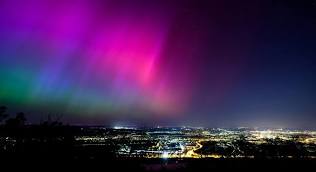
An aurora begins about 150 million kilometres away
The light appears in Earth's atmosphere, but the chain of events begins at the Sun. Solar magnetic activity can disturb the flow of charged particles and magnetic field carried through the Solar System.
Active Sun
Complex magnetic fields around sunspots can store and release large amounts of energy.
Solar eruption
Solar flares and coronal mass ejections can accompany periods of intense solar magnetic activity.
Earth's magnetosphere
When a strong solar disturbance reaches Earth, it interacts with our planet's magnetic field.
Atmospheric glow
Energetic particles excite atoms and molecules high in the atmosphere. As they release that energy, visible auroral light is produced.
What happens when a geomagnetic storm becomes stronger?
Auroras usually form within rings around Earth's magnetic poles known as the auroral ovals. Strong geomagnetic disturbances can expand these ovals, allowing aurora to become visible much farther from the poles.
Increase the storm strength
Move the slider from quiet space weather toward a strong geomagnetic storm and watch the auroral oval spread toward lower latitudes.
The atmosphere acts like a giant glowing laboratory
Aurora colour depends mainly on which atmospheric species are excited, the altitude of the interaction and the energy of the incoming particles.
Green
The most familiar auroral colour is associated primarily with excited atomic oxygen in the upper atmosphere.
Red
Atomic oxygen can also produce deep red aurora, particularly at higher altitudes and under suitable excitation conditions.
Blue and purple
Molecular nitrogen and ionised nitrogen contribute blue, violet and purplish emissions, especially in energetic displays.
Sunspot, solar flare and CME are not the same thing
Sunspot
A comparatively cool, dark region of the visible solar surface associated with concentrated magnetic fields.
Solar flare
A rapid release of electromagnetic energy from an active region. Radiation from a flare reaches Earth at the speed of light.
Coronal mass ejection
A large eruption of magnetised plasma from the Sun's corona. If directed toward Earth, a CME can strongly disturb the magnetosphere.
The active solar region on 11 May 2024
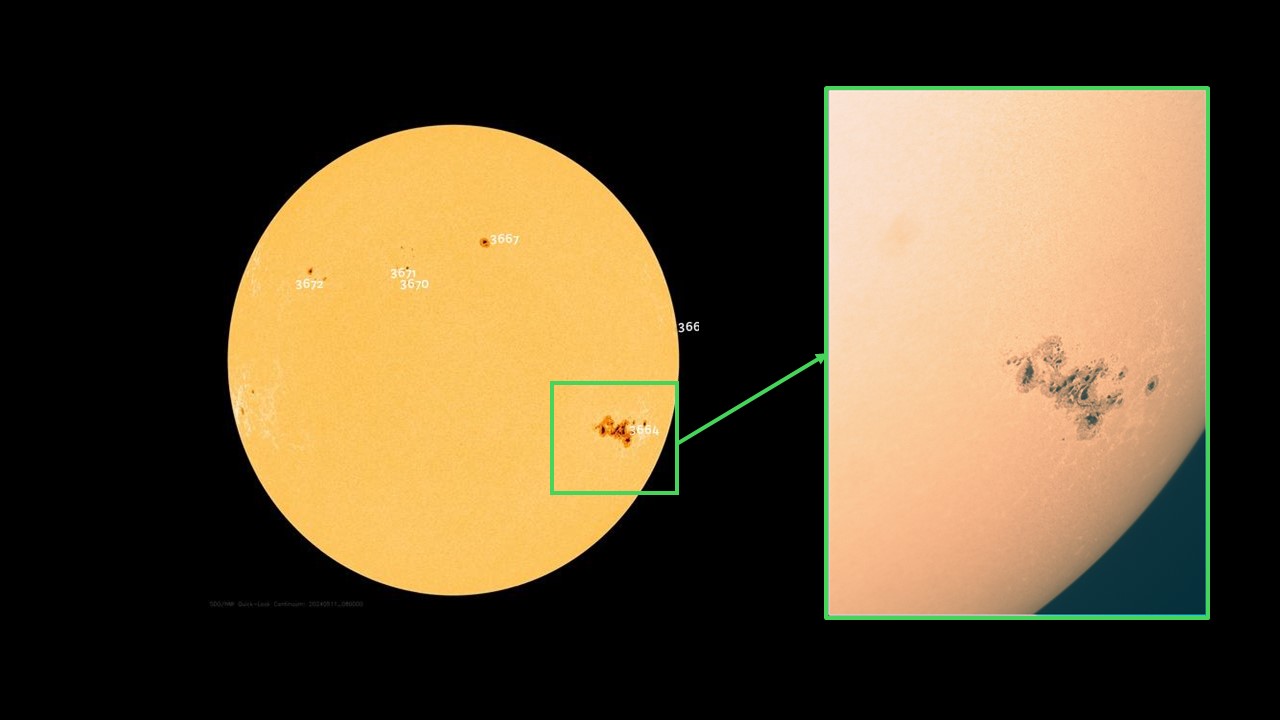
From solar activity to aurora
This image compares the active region visible on the Sun with our own close-up observation made on 11 May 2024.
The large and magnetically complex sunspot region was associated with the sequence of solar eruptions that drove the remarkable geomagnetic activity observed around Earth.
Our close-up was obtained using our telescope and CCD camera.
What does the Kp index tell us?
Kp is a planetary index used to describe the overall level of disturbance in Earth's geomagnetic field. Higher values generally mean that auroral activity can extend farther away from the polar regions.
Aurora is generally concentrated toward high geomagnetic latitudes.
The auroral oval can expand and displays may become visible farther from the polar regions.
Aurora can occasionally be visible at surprisingly low geomagnetic latitudes when conditions are favourable.
Comments