How to Measure the Sun's Rotation Using Sunspots
Sunspots move across the visible solar disc as the Sun rotates. By following the same active region on different days, we can turn a sequence of solar images into a simple measurement of solar rotation.
Yes — you can measure the Sun's rotation yourself. Track the same sunspot over several days, measure how far it moves in longitude, and use its angular motion to estimate a rotation period.
The idea
The Sun does not remain fixed beneath its visible surface features. It rotates, carrying sunspots and active regions across the solar disc. If the same sunspot can be identified on observations made several days apart, its motion becomes a natural tracer of that rotation.
This is a particularly satisfying astronomy experiment because the rotation is not merely something we read about: we can see it happening in our own images.
A real observation: active region 3792
I photographed the Sun on 20 August 2024 and again three days later, on 23 August 2024. The same active region — AR 3792 — can be followed as it moves across the solar disc.
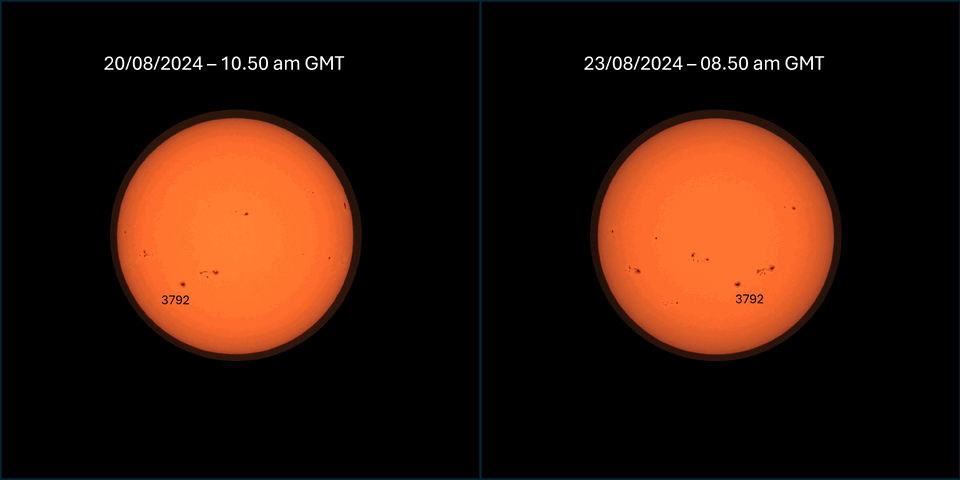
Its latitude changed very little, while the quoted longitude moved from 20° east to 21° west. The simple longitudinal displacement between those values is therefore approximately 41° in three days.
Calculate the rotation period
If 41° of motion takes three days, we can ask how long the same rate of angular motion would take to cover a full 360° rotation.
Our 26.3-day estimate falls within the expected range for solar rotation and is particularly encouraging considering that it comes from only two observations separated by three days.
Why isn't there one single rotation period for the Sun?
The Sun is not a rigid solid body. Much of it is plasma, and different solar latitudes rotate at different rates. This is known as differential rotation. Regions near the equator rotate faster than regions at higher latitudes.
Differential rotation
A sunspot near the solar equator will not necessarily give exactly the same rotation period as an active region much farther north or south. AR 3792 was around 17–18° south, so its latitude matters when interpreting the result.
The Sun is not a solid sphere
On a rigid body every latitude would complete a turn together. The Sun behaves differently, allowing its equatorial and higher-latitude regions to rotate at different angular rates.
Synodic versus sidereal solar rotation
There is another subtlety. While we observe the Sun rotating, the Earth is itself moving around the Sun. The rotation period inferred from the changing view seen from Earth is therefore not exactly the same as the Sun's rotation period relative to distant stars.
Synodic rotation
This describes the apparent solar rotation as viewed from the moving Earth. A commonly used reference is the Carrington rotation, approximately 27.2753 days in the synodic frame.
Sidereal rotation
This measures rotation relative to distant stars rather than the moving Earth. The Carrington sidereal rotation period is approximately 25.38 days.
It is best treated as a simple short-baseline observational estimate derived from the quoted longitude change of one active region. A more rigorous determination would account explicitly for the coordinate system, Earth's orbital motion, measurement uncertainty and solar differential rotation.
Further reading: NASA — The Sun · NOAA Space Weather Prediction Center
How to repeat the experiment yourself
The experiment becomes much stronger when the observations are made systematically. A smart telescope such as the Seestar S50, used in its safe solar observing configuration, makes repeated imaging particularly convenient.
-
Observe the Sun safely.
Use appropriate solar observing equipment and obtain a clear image showing identifiable sunspots. -
Choose a distinctive active region.
Select a sunspot or group that can be recognised reliably on subsequent days. -
Repeat the observation.
Image the Sun again after one or more days while keeping the workflow as consistent as possible. -
Identify the same region.
Compare the images and determine how its solar longitude has changed. -
Calculate the angular rate.
Divide the measured longitude change by the elapsed time to obtain degrees per day. -
Estimate the period.
Divide 360° by the measured angular rate.
You can learn more about the telescope and other quantitative observing experiments on the Seestar S50 astronomy experiments page.
Make the experiment more accurate
Two observations are enough to demonstrate the principle, but a better experiment would use several observations over perhaps a week. Instead of calculating the period from one pair of positions, record the active region's longitude at each observation.
Plot longitude against time. The slope of the best-fitting line gives an angular rate in degrees per day. The corresponding rotation period can then be estimated from:
Repeat the experiment with sunspots at different solar latitudes and it becomes possible to investigate differential rotation directly rather than simply measuring one rotation period.
From astrophotography to measurement
The most interesting part of this exercise is not the exact number obtained from one pair of images. It is that an ordinary solar observation can become quantitative astronomy.
A sequence of images lets us watch a star rotate, calculate an angular rate and investigate why the answer depends on latitude and on how the rotation period is defined.
Explore more hands-on astronomy
Measure the Moon, investigate planetary moons, study eclipses and turn telescope images into real astronomical measurements.
Explore solar astronomy
Comments