Perseid Meteor Shower
Every summer, Earth crosses a stream of tiny particles left behind by Comet 109P/Swift–Tuttle. When those particles strike our atmosphere at enormous speed, they create the bright streaks we call the Perseids.
From a comet to a streak of light
The Perseids originate from Comet 109P/Swift–Tuttle, a large comet that takes about 133 years to travel once around the Sun. During passages through the inner Solar System it releases dust and small fragments that remain distributed along its orbit.
Swift–Tuttle
The comet travels around the Sun and releases dust and small particles.
Debris stream
The particles remain spread along the comet's orbital path.
Earth crosses it
Each year Earth's orbit carries our planet through this stream.
A meteor appears
The incoming particle heats the surrounding atmosphere and produces a brief luminous trail.
Why do the meteors appear to come from Perseus?
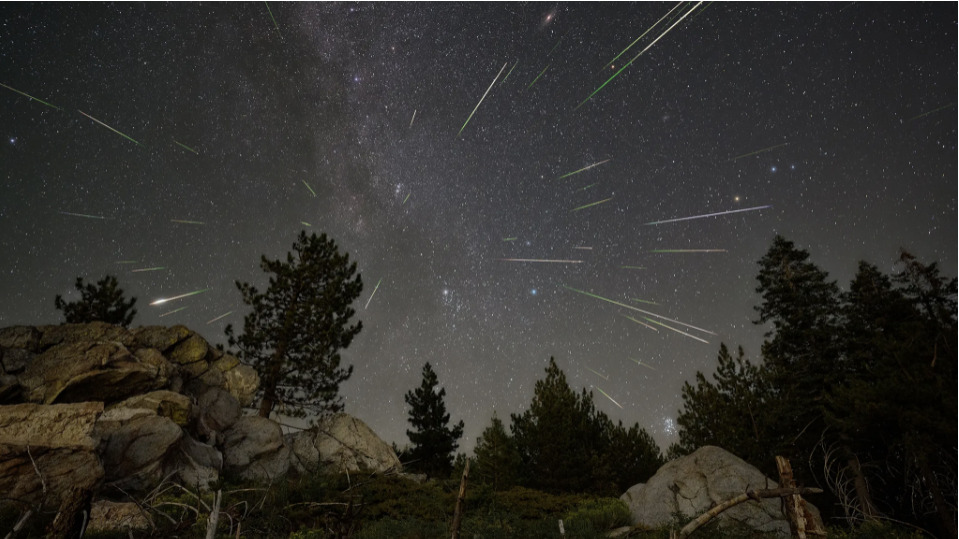
Perseid meteors can appear almost anywhere in the sky, yet if you extend their paths backwards they seem to converge near one point. That apparent point is called the radiant.
Perspective creates the radiant
The meteoroids are travelling along broadly parallel trajectories, but perspective makes those tracks appear to diverge across the sky. It is similar to railway tracks appearing to meet in the distance.
Trace the meteor trails backwards and they converge near Perseus — which is why the shower is called the Perseids.
How to watch the Perseids
Meteor observing is one of the simplest forms of astronomy. You do not need a telescope — in fact, a telescope would show far too little of the sky.
Meteoroid, meteor or meteorite?
The small rocky or dusty object while it is still travelling through space.
The streak of light produced when a meteoroid enters the atmosphere. This is what we see during the Perseids.
Material that survives its passage through the atmosphere and reaches the ground.
Are all Perseid meteors actually near Perseus?
No. The constellation tells us the apparent direction from which the particles arrive, not the physical location of the meteors.
The luminous part of a meteor occurs high in Earth's atmosphere, while the stars of Perseus lie vastly farther away. The radiant is therefore a perspective effect that gives the shower its name.
Near Perseus
Extending the apparent meteor tracks backwards leads toward a common point near the constellation Perseus.
Meteors appear everywhere
Individual Perseids can become visible far away from the radiant and may cross a large fraction of the sky.
Trace them backwards
The direction of travel is one of the clues that allows observers to decide whether a meteor belongs to the Perseid shower.
Comments