Can You Calculate Saturn's Mass Using Its Moons?
Saturn is almost 1.5 billion kilometres from the Sun, yet we can estimate its mass from Earth simply by studying how its moons orbit. The key is Kepler's Third Law.
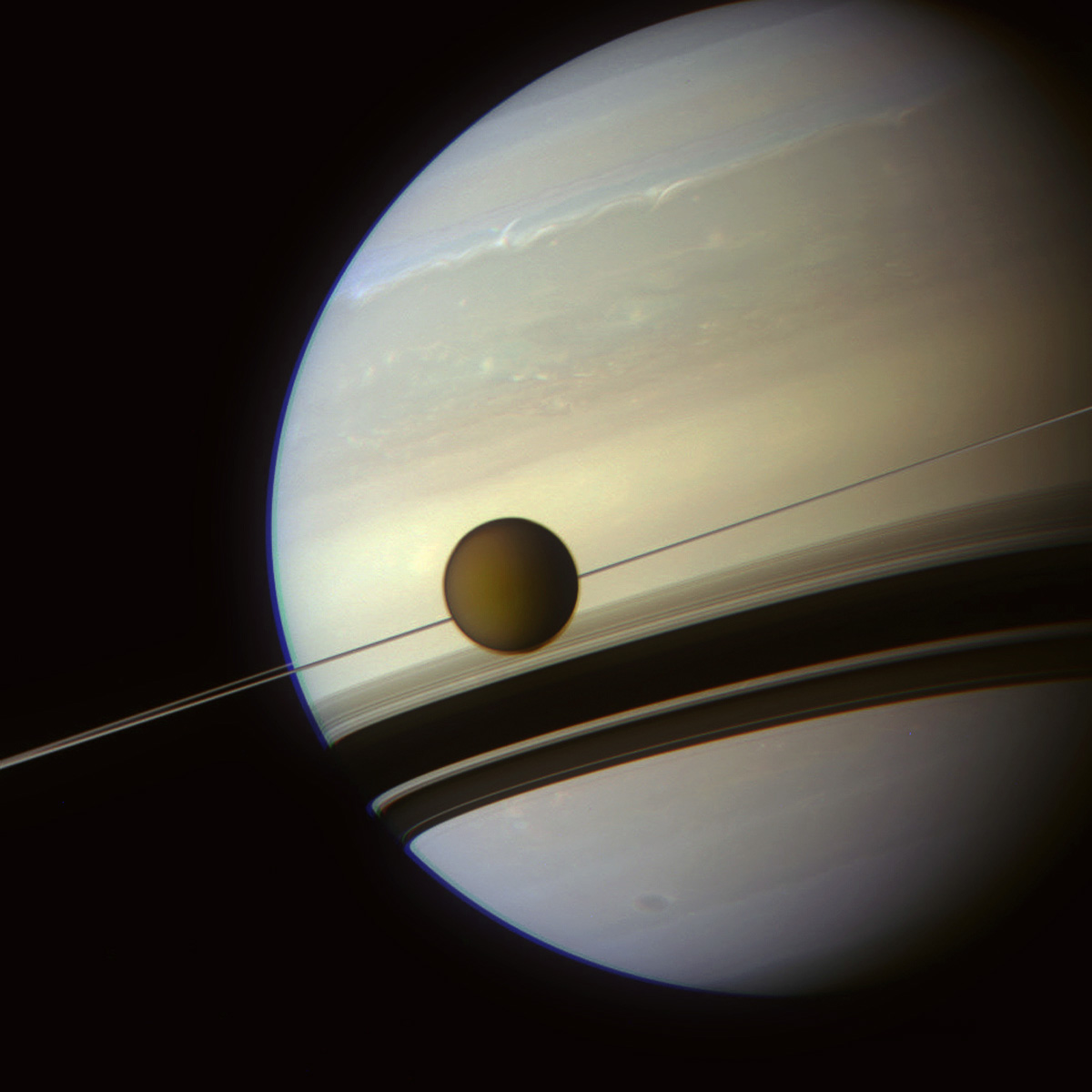
Image: Wikimedia Commons
The idea: use a moon as a gravitational probe
The faster a moon must travel to remain in orbit at a particular distance, the stronger Saturn's gravitational influence must be. That means the orbit itself contains information about Saturn's mass.
Kepler's Third Law describes the relationship between orbital period and orbital size. Combining it with Newton's law of gravitation lets us turn that relationship into a measurement of planetary mass.
Try it first with Titan
Titan gives us two measurements
Titan is especially useful because it is bright, large and has a well-defined orbit. We need its mean orbital radius and the time it takes to complete one orbit.
Convert kilometres to metres and days to seconds, then substitute the values into the equation.
Now weigh Saturn yourself
Select one or more moons. For each moon we calculate Saturn's mass independently from its orbital radius and period. With several moons, we can compare the estimates and calculate their mean.
| Moon | Orbital radius | Period | Mass estimate | Difference |
|---|
Why do several moons help?
Kepler's Third Law predicts that T² is proportional to r³. If the measurements are consistent, all the moons should follow the same relationship because they are orbiting the same planet.
That makes the moons independent gravitational probes. Combining several of them reduces our dependence on any one rounded orbital value and makes the underlying physical relationship much easier to see.
Turn this into a real observing experiment
The orbital values used above are known astronomical values, but the experiment becomes much more interesting when you connect them with your own observations.
You just weighed a planet from its moons.
This is the same powerful idea behind celestial mechanics: orbital motion lets us measure objects we cannot put on a scale.
Explore more planetary experiments
Comments