Mimas is dominated by the enormous Herschel crater, giving it a resemblance to the Death Star. Although relatively bright on paper, its proximity to Saturn's glare makes it a challenging visual target.
Meet Saturn's Moons
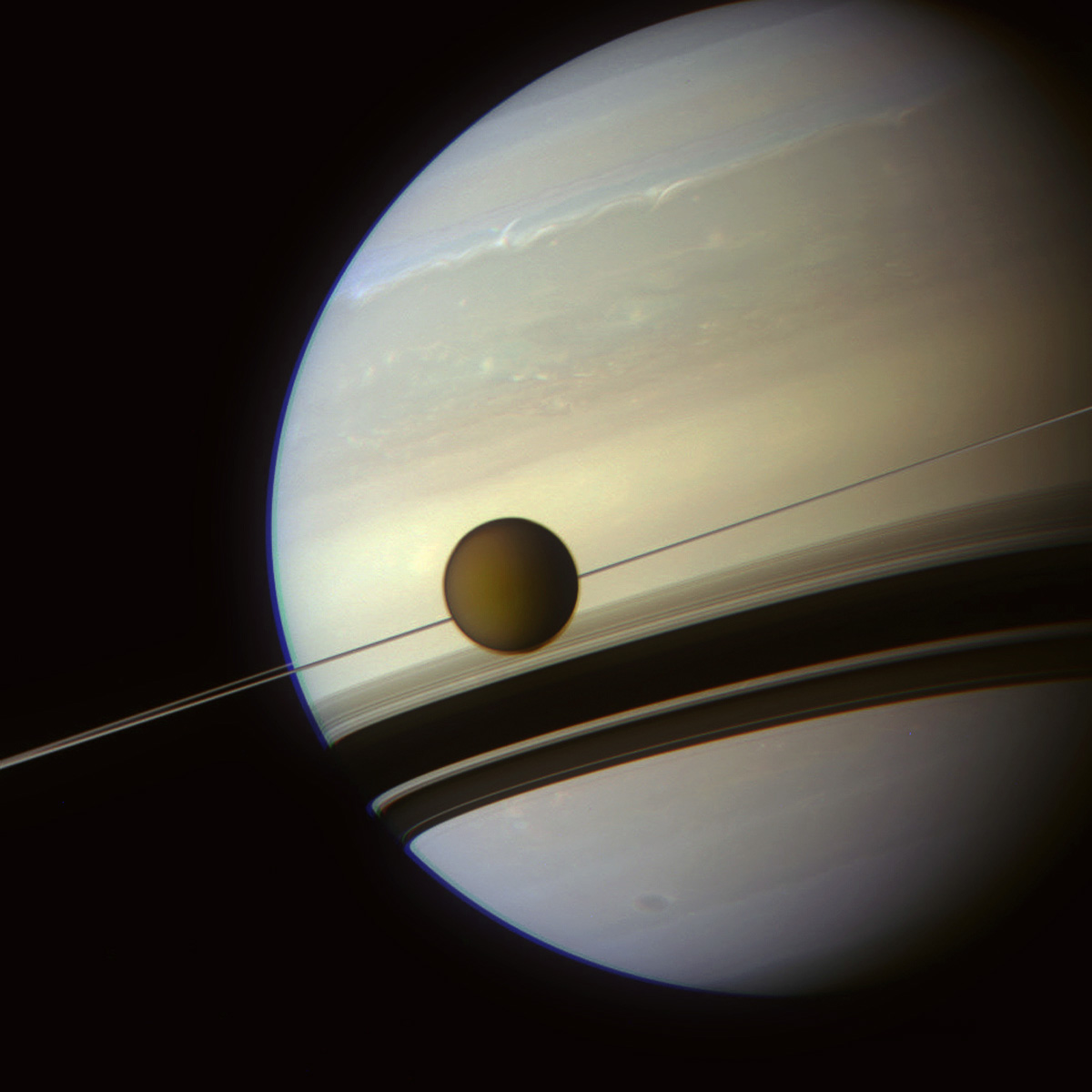
Saturn is surrounded by an extraordinary family of moons. Some are tiny shepherd satellites embedded close to the rings, while others are worlds in their own right — including atmospheric Titan and ocean-bearing Enceladus.
Image via Wikimedia Commons
Seven moons to know
These are the seven satellites used in our interactive Saturn ephemeris. Their very different orbital distances and periods also make them ideal for exploring Kepler's Third Law.
Enceladus is one of the Solar System's most fascinating worlds. Jets of water-rich material erupt from fractures near its south pole, providing evidence for a subsurface ocean.
Tethys is an icy moon marked by the huge Odysseus impact basin and the enormous Ithaca Chasma. It is one of the more accessible inner moons for suitably equipped observers.
Dione is a bright icy satellite with heavily cratered terrain and long fractures. It orbits farther from Saturn than Tethys and can be easier to separate from the planet's glare.
Rhea is Saturn's second-largest moon. Its relatively large size and brightness make it one of the more practical Saturnian satellites for amateur observations.
Titan is Saturn's largest moon and usually the easiest satellite to identify in an amateur telescope. It has a dense nitrogen-rich atmosphere and lakes and seas of liquid hydrocarbons.
Iapetus has one bright hemisphere and one extraordinarily dark hemisphere, so its apparent brightness changes considerably during its 79-day orbit around Saturn.
Can you see Saturn's moons yourself?
Start with Titan
Titan is by far the best starting point. It is bright enough to appear in relatively modest telescopes and travels far enough from Saturn that it is usually easier to separate from the planet's glare.
Rhea, Tethys and Dione are progressively more demanding. Iapetus can be well separated from Saturn but its brightness varies strongly depending on which hemisphere faces us.
Then identify what you recorded
A faint point in an image is not automatically a moon. Compare your observation time with an ephemeris to predict where each satellite should have been.
Saturn moon reference table
The table below preserves the broader dataset from the original Show Me The Sky guide. The seven moons used by our ephemeris and mass experiment are highlighted.
| Moon | Min diameter (km) | Max diameter (km) | Orbital distance (km) | Period (days) | Discoverer | Year | Magnitude |
|---|---|---|---|---|---|---|---|
| Pan | 20 | 20 | 133,585 | 0.58 | Voyager 2 | 1990 | — |
| Atlas | 37 | 37 | 137,670 | 0.60 | Voyager 1 | 1980 | 18 |
| Prometheus | 68 | 148 | 139,353 | 0.63 | Voyager 1 | 1980 | 15.8 |
| Pandora | 52 | 110 | 141,700 | 0.63 | Voyager 1 | 1980 | 16.5 |
| Epimetheus | 110 | 138 | 151,422 | 0.69 | R. Walker | 1966 | 15.7 |
| Janus | 154 | 194 | 151,472 | 0.69 | Audouin Dollfus | 1966 | 14.5 |
| Mimas | 383 | 418 | 185,520 | 0.94 | William Herschel | 1789 | 12.9 |
| Enceladus | 489 | 513 | 238,020 | 1.37 | William Herschel | 1789 | 11.7 |
| Tethys | 1,051 | 1,071 | 294,660 | 1.89 | Giovanni Cassini | 1684 | 10.2 |
| Telesto | 15 | 30 | 294,660 | 1.89 | B. Smith et al. | 1980 | 18.7 |
| Calypso | 16 | 30 | 294,660 | 1.89 | D. Pascu et al. | 1980 | 18 |
| Dione | 1,120 | 1,120 | 377,400 | 2.74 | Giovanni Cassini | 1684 | 10.4 |
| Helene | 30 | 36 | 377,400 | 2.74 | P. Laques et al. | 1980 | 18.5 |
| Rhea | 1,528 | 1,528 | 527,040 | 4.52 | Giovanni Cassini | 1672 | 9.7 |
| Titan | 5,150 | 5,150 | 1,221,830 | 15.95 | Christiaan Huygens | 1655 | 8.28 |
| Hyperion | 225 | 360 | 1,481,100 | 21.28 | W. & G. Bond / W. Lassell | 1848 | 14.19 |
| Iapetus | 1,436 | 1,436 | 3,561,300 | 79.33 | Giovanni Cassini | 1671 | 10.2 |
| Phoebe | 220 | 220 | 12,952,000 | 550.48 | William Pickering | 1898 | 16.45 |
Magnitudes are approximate and observing difficulty depends strongly on Saturn's glare, atmospheric conditions, telescope aperture, imaging technique and the moon's apparent separation from the planet.
Now put the data to work. First use our interactive ephemeris to determine where the moons should appear. Then use their orbital distances and periods with Kepler's Third Law to calculate the mass of Saturn itself.
Comments