How to Measure the Diameter of the Moon
More than two thousand years ago, Greek astronomers realised that a lunar eclipse could reveal the relative sizes of the Earth and Moon. Combined with a measurement of the Earth itself, that geometry gives us the size of the Moon.
The key idea: first estimate the size of the Earth, then use the Earth's shadow during a lunar eclipse to determine how large the Moon is relative to our planet.
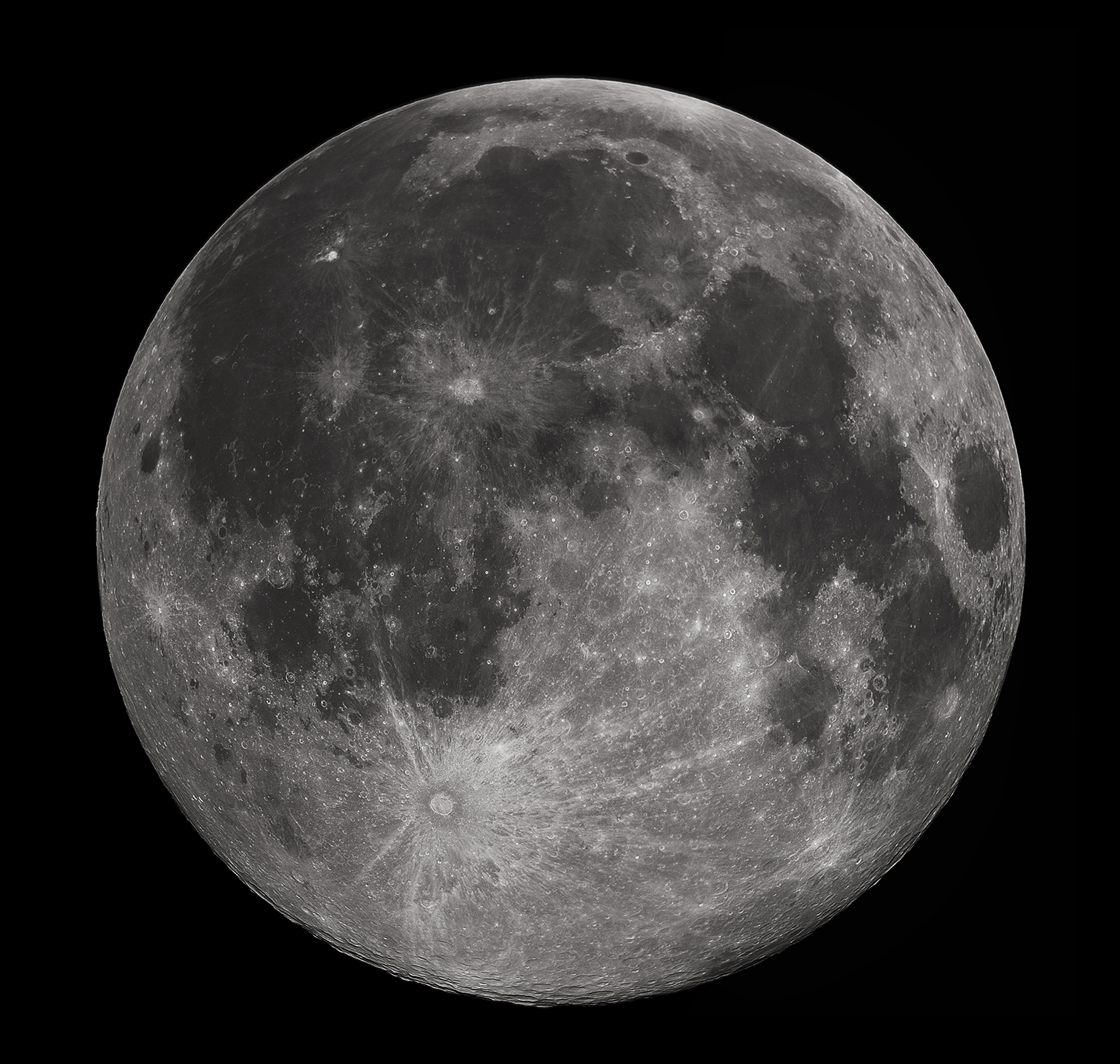
The problem faced by ancient astronomers
Today we know that the Moon has a mean diameter of about 3,475 km. Ancient astronomers had no spacecraft, radar or laser-ranging measurements. They had observations, shadows, eclipses and geometry.
The remarkable insight was that these were enough. If the size of the Earth could first be determined, the geometry of a lunar eclipse could provide a route to estimating the size of the Moon.
Step 1: measure the Earth
In the third century BC, Eratosthenes of Cyrene used the different angles of sunlight measured at two locations in Egypt to estimate the circumference of the Earth.
In the simplified example used here, the difference in solar angle is 7.2° and the distance between the two locations is approximately 790 km.
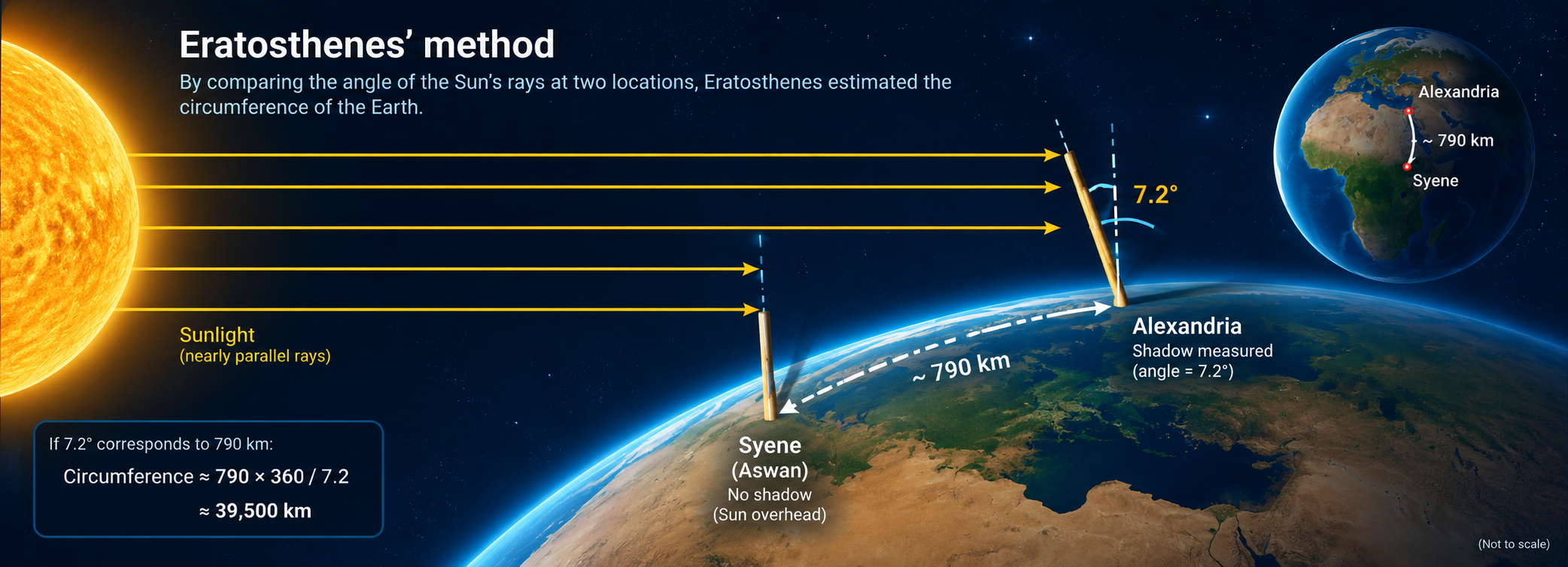
Once the circumference is known, the diameter follows from the familiar relationship between circumference and diameter:
The modern mean diameter of the Earth is about 12,742 km, so this simplified ancient-style calculation gets remarkably close using little more than shadows, distance and geometry.
Step 2: use a lunar eclipse
A lunar eclipse occurs when the Moon passes through the Earth's shadow. Because the Moon moves through that shadow at a measurable rate, the eclipse provides a way to compare the apparent width of the Moon with the width of the Earth's shadow at the Moon's distance.
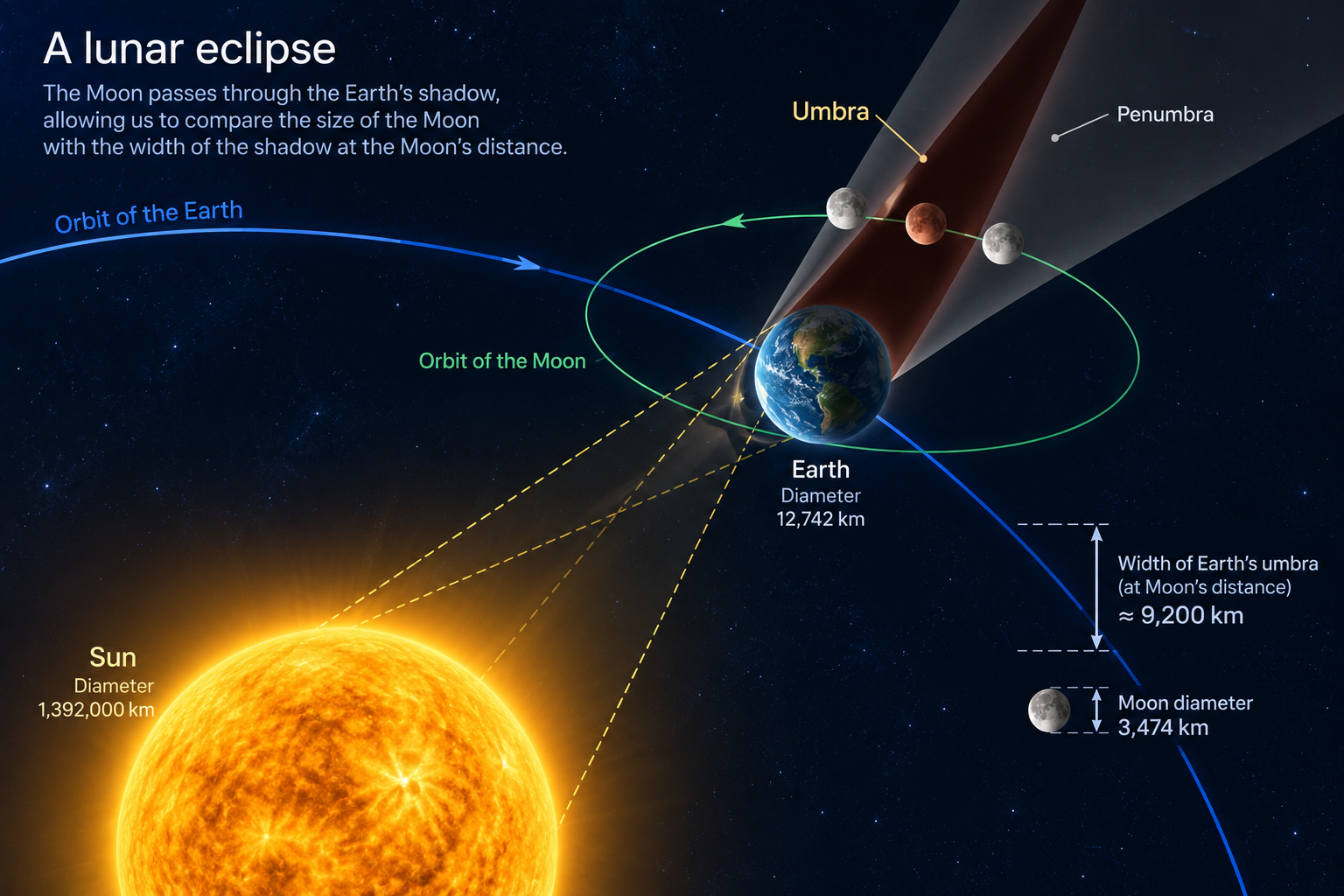
Aristarchus of Samos studied lunar-eclipse geometry in antiquity. By comparing the Moon with the Earth's shadow, ancient astronomers could estimate the relative scale of the Earth and Moon.
The Earth's shadow at the Moon is not exactly the same width as the Earth itself: sunlight converges behind the Earth to form a tapering umbra. A rigorous calculation therefore needs to account for the geometry of the Sun, Earth and Moon. The simple comparison nevertheless reveals the essential idea.
Step 3: compare the Earth and Moon
The Earth is about 3.7 times wider than the Moon. Once the diameter of the Earth has been established, that ratio immediately provides an estimate of the Moon's diameter.
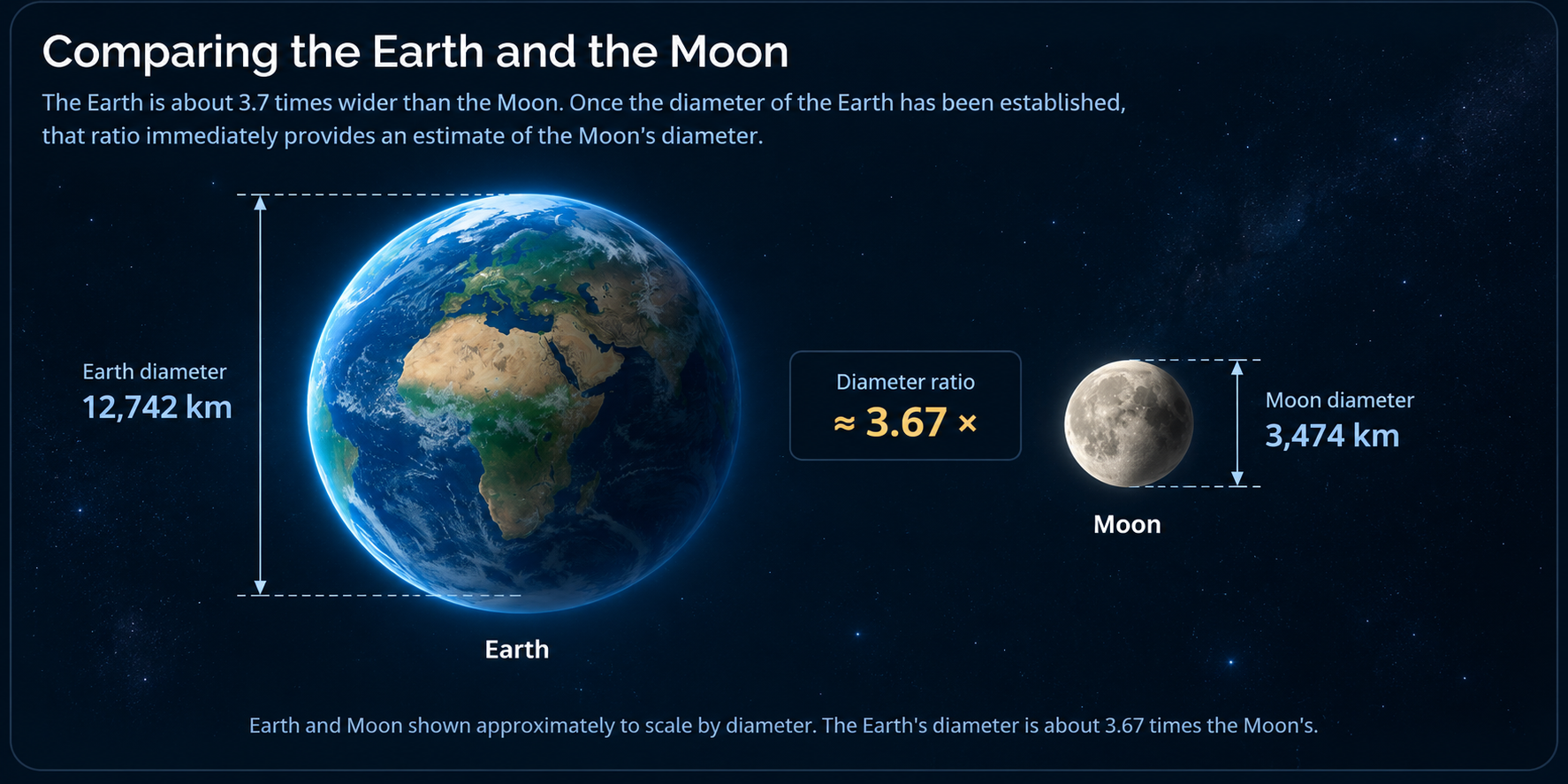
Given the simplicity of the method, this is impressively close to the modern value. Refining the geometry and measurements brings the result closer still.
The chain of astronomical reasoning
What makes this experiment especially interesting is that each measurement allows another one to be made.
-
Measure the Earth from shadows.
Eratosthenes-style geometry gives the circumference and diameter of our planet. -
Observe a lunar eclipse.
The Moon crossing Earth's shadow reveals the relative scale of the two bodies. -
Estimate the Moon's diameter.
Combining the ratio with Earth's known size gives a lunar diameter of roughly three and a half thousand kilometres. -
Measure the Moon's angular size.
From Earth, the Moon appears about half a degree wide, although the exact value changes because its distance varies. -
Estimate the Earth–Moon distance.
Once physical diameter and angular diameter are known, simple geometry provides another remarkable measurement.
From the Moon's size to its distance
Knowing the Moon's physical diameter unlocks another experiment. Measure how large the Moon appears in the sky and geometry can be used to estimate how far away it is.
For an apparent angular diameter of approximately 0.51° and a physical diameter of roughly 3,475 km, the result is around 390,000 km, depending on the Moon's actual distance at the time.
Can we measure the Earth–Moon distance ourselves?
Yes. We repeated the measurement using real Seestar S50 observations, calibrated image geometry and dozens of lunar measurements, then compared the result with NASA/JPL Horizons.
Measure the distance to the Moon
Comments