Why Does Something Look Smaller When It Is Farther Away?
Apparent size describes how large an object appears in the sky. It depends on both its true physical diameter and its distance from you.
From physical size to angular size
Imagine holding an apple at arm's length. Move exactly the same apple farther away and it appears smaller even though its physical diameter has not changed.
Astronomy uses the same idea when describing the apparent diameter of the Moon, planets and other objects.
We measure that apparent diameter as an angle. A full circle contains 360°. Because astronomical angles are often tiny, we commonly use arcminutes and arcseconds.
How much can apparent size change?
Select a Solar System object to compare its apparent angular diameter at its approximate closest and farthest distances from Earth.
Moon
Why doesn't the Moon always look exactly the same size?
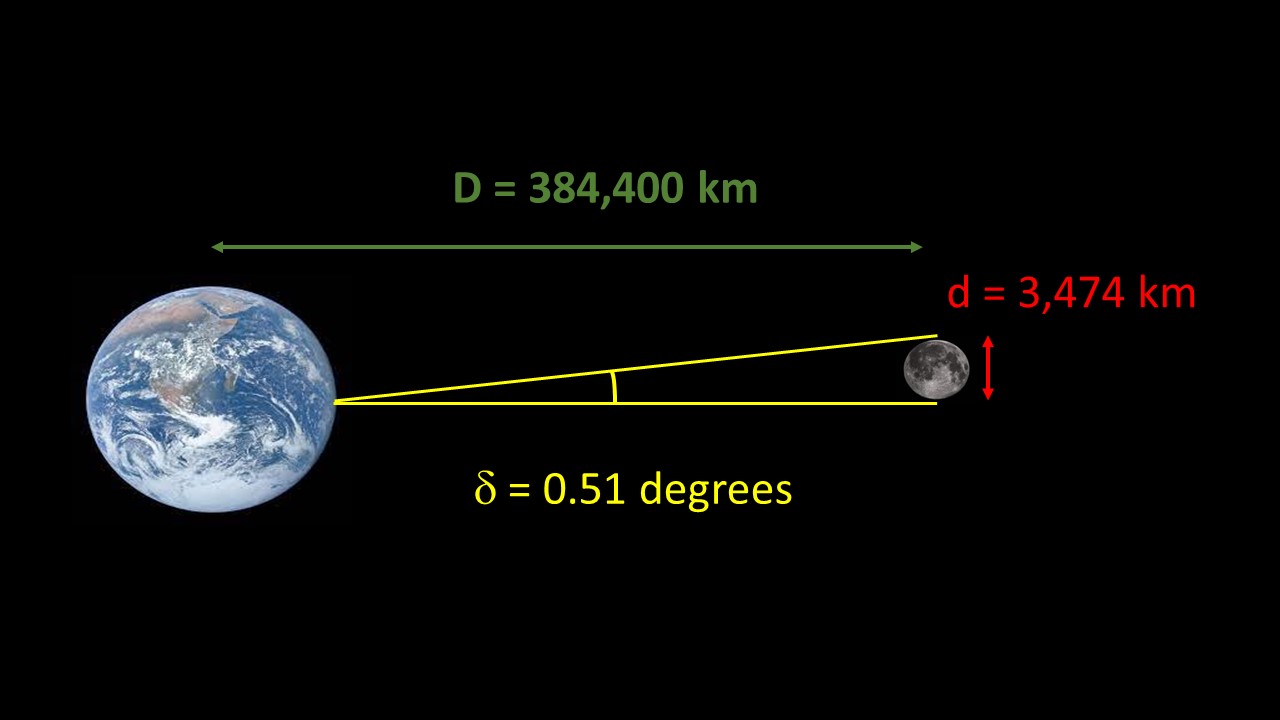
The Moon is about 3,474 km across and approximately 384,400 km from Earth on average.
That gives an apparent angular diameter of approximately half a degree — about 31 arcminutes.
But the Moon's orbit is elliptical. Its distance from Earth changes, so its apparent diameter also changes slightly during each orbit.
Mars, Jupiter, Venus and the other planets can look substantially larger or smaller depending on where Earth and the planet are in their orbits.
Telescopes see angles, not kilometres
An object can be physically enormous but still appear tiny because of its distance. That is why angular size is one of the most useful quantities when planning astronomical observations.
Once you know an object's apparent angular diameter, you can compare it with your telescope or camera's field of view to predict how large it will appear in an image.
Comments