The Crab Nebula: A Star That Exploded in 1054
Almost a thousand years ago, a brilliant new point of light appeared in the sky. Today we can still observe the expanding remains of that stellar explosion: the Crab Nebula, Messier 1.
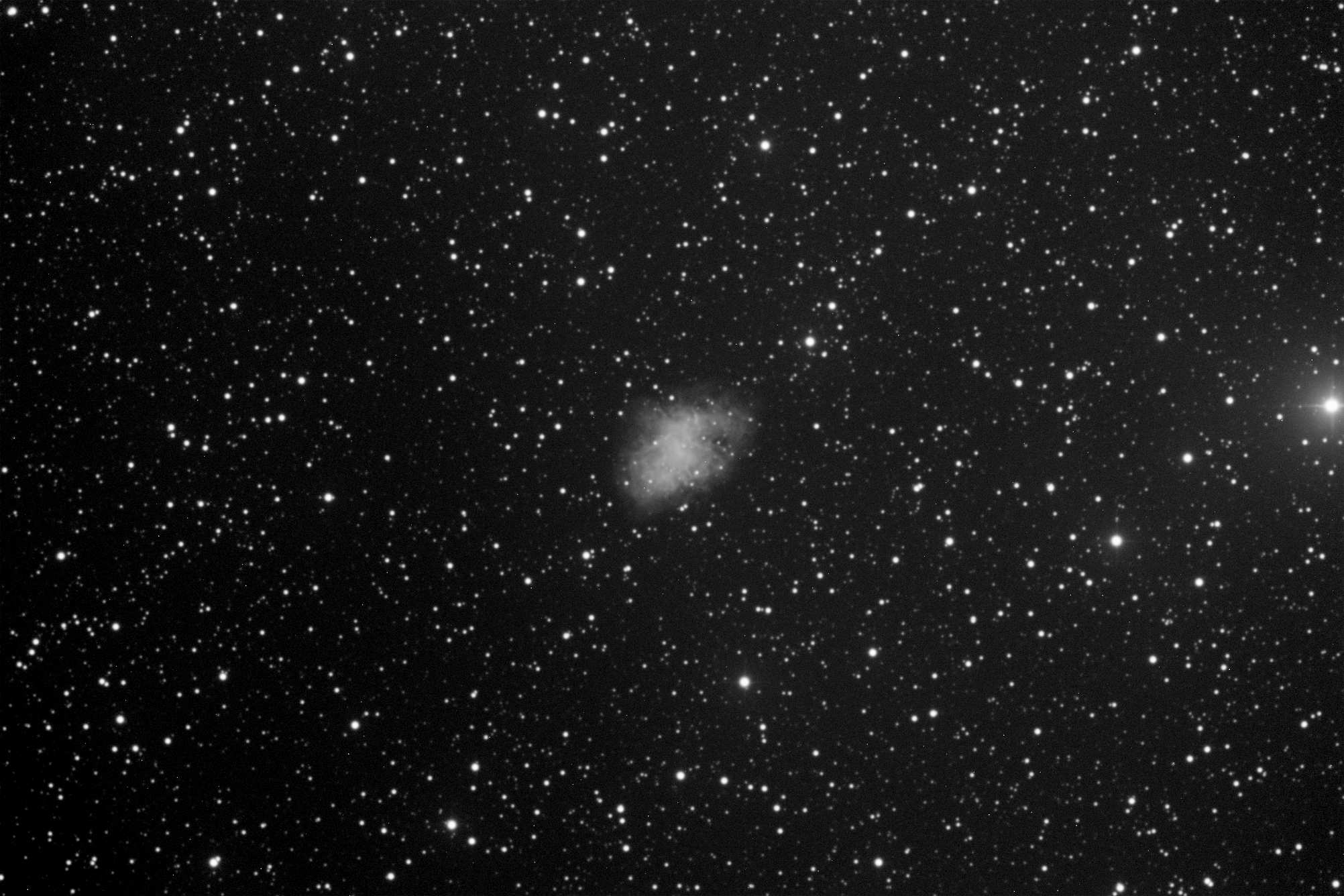
An explosion whose aftermath is still changing
One astronomical event connects a millennium of observers
In 1054, astronomers in East Asia recorded a new star in the direction of Taurus. It became bright enough to be visible during daylight. What they saw was not a new star being born, but a massive star reaching the end of its life.
The guest star appears
A brilliant transient object becomes visible in Taurus and is recorded by astronomers.
John Bevis
The faint nebula later known as the Crab is identified telescopically by English astronomer John Bevis.
Messier encounters it
Charles Messier observes the fuzzy object while searching for a comet. It becomes the first entry — M1 — in his famous catalogue.
We watch it expand
Modern telescopes reveal gas filaments, energetic particles and a rapidly rotating neutron star at the centre.
Watch nearly 1,000 years of expansion
Move through time from the supernova of 1054 to the present day. The visualization illustrates how an expanding shell of material grows outward from the explosion.
Move through time
The farther we move from 1054, the farther the ejecta have travelled into surrounding space.
The star disappeared — but its core did not
Massive star
Before 1054, a massive star occupied this part of the Galaxy.
Core collapse
When the star could no longer support its core, gravitational collapse triggered the supernova.
Expanding remnant
Stellar material was hurled outward and still forms the filamentary structure that we observe today.
Neutron star
The collapsed core survives as an incredibly dense and rapidly rotating object.
A lighthouse rotating thirty times every second
The neutron star at the centre is a pulsar. Beams of radiation sweep through space as the star rotates. When a beam crosses our line of sight, we detect a pulse — much like seeing the flash of a distant lighthouse.
The Crab Pulsar
Approximately thirty rotations occur each second.
The pulsar drives a powerful wind of high-energy particles that helps power the nebula's glow. The Crab therefore remains an active, energetic system rather than simply a passive cloud of old debris.
The Crab Nebula is powered from within
Some of the visible filaments are material expelled by the exploding star. But the central pulsar also injects enormous amounts of energy into its surroundings.
Fast-moving charged particles interact with strong magnetic fields and produce radiation across much of the electromagnetic spectrum. That is why astronomers study the Crab not only in visible light, but also in radio, infrared, ultraviolet, X-rays and gamma rays.
The Crab Nebula helped inspire Messier's catalogue
Charles Messier was searching the sky for comets. Objects such as the Crab looked fuzzy through eighteenth-century telescopes and could easily be confused with a comet.
Messier therefore began listing these permanent fuzzy objects. The Crab Nebula became Messier 1 — M1. You can explore the story further in our guide to Charles Messier and his catalogue.
Can you see the Crab Nebula?
Find Taurus
M1 lies in Taurus, near the tip of one of the Bull's horns and not far from the bright star Zeta Tauri.
Use a dark sky
With an apparent magnitude around 8.4, the Crab is not visible to the unaided eye. Dark conditions make a substantial difference when observing its faint glow.
Image it
A camera can accumulate light over time and reveal far more structure than is apparent visually. Our image above used a five-minute exposure.
Comments