SN 2023ixf
Core-collapse supernova
A massive star reaches the end of its nuclear-burning life and its core collapses gravitationally. Type II supernovae show hydrogen in their spectra.
In May 2023 a new point of light appeared inside the Pinwheel Galaxy, M101. It was SN 2023ixf — the catastrophic death of a massive star, witnessed from roughly 21 million light-years away.
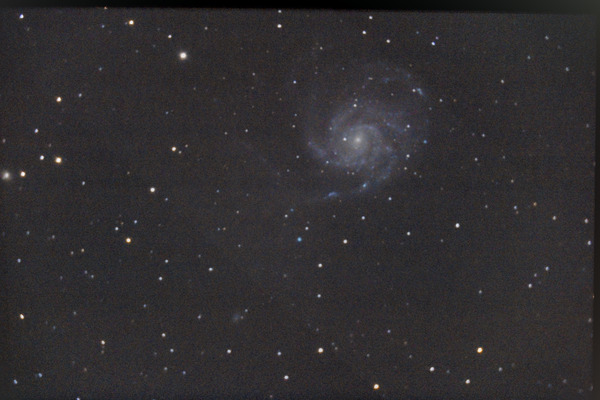
SN 2023ixf was discovered in May 2023 in one of the spiral arms of Messier 101. Spectroscopic observations identified it as a Type II supernova, indicating the core collapse of a massive star.
Move the slider from the explosion in M101 to the arrival of its light at Earth. This diagram is schematic: the galaxy and Solar System are vastly enlarged so that we can see them.
When we look deep into space, we are also looking into the past. Distance becomes a kind of astronomical time machine.
For millions of years nuclear fusion produces energy that helps support the star against gravity.
Successive fusion stages build increasingly heavy nuclei in the stellar interior.
Eventually the core can no longer generate enough pressure to oppose gravity, and it collapses extremely rapidly.
The collapse triggers an enormous release of energy and the outer layers of the star are expelled.
Depending on the progenitor and collapse, a neutron star or black hole may remain.
A massive star reaches the end of its nuclear-burning life and its core collapses gravitationally. Type II supernovae show hydrogen in their spectra.
Type Ia explosions involve a white dwarf in a binary system. Their physical origin is fundamentally different from the collapse of a massive star.
Long before SN 2023ixf appeared, we had already photographed M101. The supernova therefore provides an interesting reminder that a galaxy which looks almost unchanged during a human lifetime can suddenly host an event bright enough to be detected by amateur astronomers.
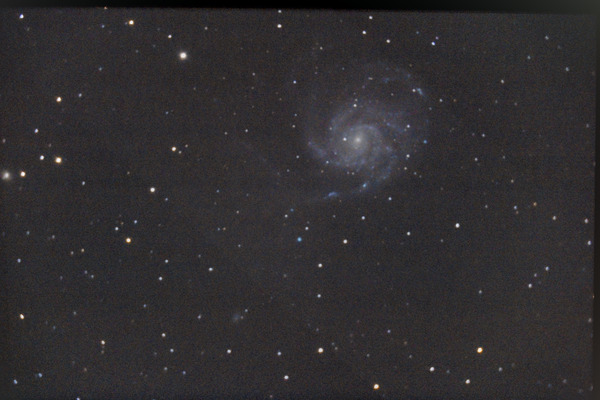
Supernovae appear unexpectedly. Repeated images of the same galaxy allow observers to notice a new point of light that was absent before.
In fact, SN 2023ixf itself was first reported by experienced amateur astronomer Koichi Itagaki in Japan.
Normally the individual stars of M101 are far too faint to see in a typical amateur image. During a supernova, however, one star can temporarily become extraordinarily luminous.
That means a new stellar-looking point can emerge within the fuzzy structure of a galaxy millions of light-years away.
Massive stars manufacture elements during their lives, while the explosion and its extreme conditions contribute to the production and dispersal of additional nuclei. The expanding debris returns enriched material to interstellar space.
The star's outer layers are blasted into the surrounding interstellar medium.
Material forged inside stars and during explosive processes is dispersed through the galaxy.
Enriched gas can later become incorporated into new generations of stars and planetary systems.
Many of the elements present in planets and living organisms were produced by earlier generations of stars.
A supernova is the explosion itself. A supernova remnant is the expanding structure left behind as the ejected material interacts with surrounding gas.
The Crab Nebula, M1, is a famous example. Its supernova was observed from Earth in 1054, while today we observe the expanding remnant and the pulsar at its centre.
Comments