Why Do Venus & Mercury Have Phases?
Venus and Mercury can appear as thin crescents, half illuminated, gibbous or almost full — remarkably similar to our Moon. The reason is written directly into the geometry of their orbits.
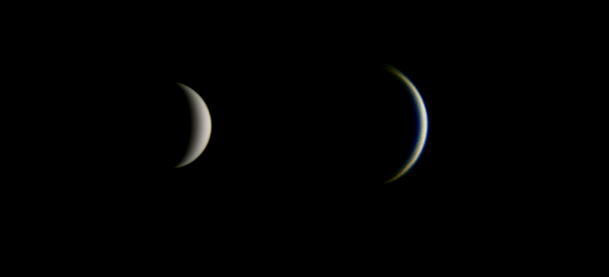
One planet. Many appearances.
Half of a planet is always illuminated by the Sun. What changes is the fraction of that illuminated hemisphere that faces Earth. Because Venus and Mercury orbit inside Earth's orbit, we can view them from a particularly wide range of Sun–planet–Earth angles.
Crescent
When an inferior planet lies broadly between Earth and the Sun, most of its illuminated hemisphere faces away from us, leaving a crescent visible from Earth.
Quarter
At intermediate orbital geometry, roughly half of the visible disc can be illuminated, producing a phase reminiscent of a quarter Moon.
Gibbous & nearly full
On the far side of the Sun we see much more of the illuminated hemisphere. The planet becomes gibbous and can approach a nearly full phase.
Move Venus around the Sun
Drag the slider to move Venus around a simplified orbit. Watch how its phase changes as the viewing geometry from Earth changes.
Orbital position
This diagram is deliberately simplified: the orbits are shown face-on so the phase geometry is easy to see.
Why does crescent Venus look bigger?
Venus does something particularly striking through a telescope: its apparent size and illuminated fraction change in opposite directions.
Large crescent
Near the Earth-facing part of its orbit, Venus is much closer to us. Its apparent disc becomes larger, but only a small fraction of its daylight side faces Earth.
Small gibbous Venus
On the far side of the Sun, Venus is much farther away. We see more of its illuminated hemisphere, but its apparent diameter is considerably smaller.
Do Mars, Jupiter and Saturn have phases?
Yes — but the geometry is different.
Mars
Mars can show a noticeable gibbous phase because its orbit is relatively close to Earth's. It never appears as a thin crescent from Earth.
Jupiter & Saturn
From Earth these planets remain very close to fully illuminated. Their phase changes are much subtler than those of Venus or Mercury.
Uranus & Neptune
Their great distance means the Sun and Earth appear almost in the same direction from the planet, so their visible discs are essentially full.
Galileo and the phases of Venus
In 1610, Galileo observed that Venus displayed a broad range of phases. This was a crucial observation because it showed that Venus travels around the Sun.
The complete sequence of phases was incompatible with the simple Ptolemaic arrangement in which Venus always remained between Earth and the Sun. The observations therefore became important evidence for a Sun-centred planetary system.
Comments