Can You Watch an Asteroid Move Across the Sky?
Vesta is much more than a faint point of light. It is one of the largest bodies in the asteroid belt, a surviving protoplanet from the early Solar System — and with two photographs taken on consecutive nights, you can actually see it move.
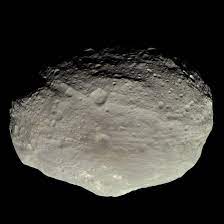
A small world that almost became a planet
Two nights are enough to reveal Vesta's motion
The animation below compares observations made on 11 and 12 April 2021. Most of the stars remain in the same positions. One point changes position: Vesta.
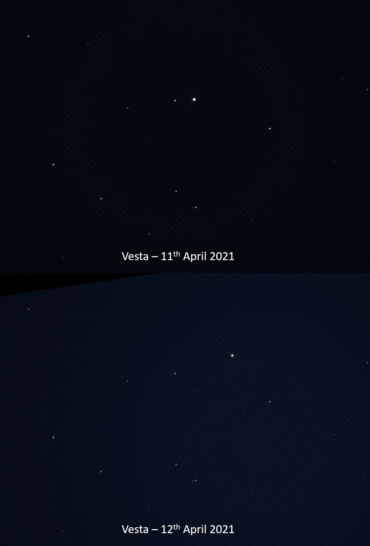
Try this experiment yourself
Where is Vesta in the asteroid belt?
Move the slider through one Vesta orbit. The diagram is schematic, but the relative orbital distances of Mars, Vesta and Jupiter are represented approximately.
Follow one orbit
Mars lies inside Vesta's orbit. Jupiter lies much farther out. The main asteroid belt occupies the broad region between them.
Vesta is unusually planet-like
Early in Solar System history, heat melted part of Vesta's interior. Dense material sank inward while lighter material formed mantle and crust. This process, called differentiation, also occurred in the terrestrial planets.
Vesta therefore preserves evidence of the planetary building process. Rather than being simply an irregular pile of primitive material, it developed a crust, mantle and core.
Vesta is large for an asteroid — but still tiny beside the Moon
Vesta
About 525 km across. Its irregular shape carries the scars of enormous collisions.
Ceres
Roughly 940 km across and massive enough to be classified as a dwarf planet.
Earth's Moon
About 3,475 km across — more than six times Vesta's diameter. The circles above are compressed for display and are not to scale relative to one another.
A crater almost as wide as Vesta itself
Vesta's southern hemisphere is dominated by the enormous Rheasilvia impact basin. It is roughly 500 km across — about 95% of Vesta's mean diameter.
The collision excavated material from deep inside Vesta and ejected fragments into space. Some of those fragments eventually reached Earth.
We have samples of Vesta — without ever landing there
Meteorites known as howardites, eucrites and diogenites — collectively called HED meteorites — have compositions that match Vesta.
NASA's Dawn mission confirmed that connection by comparing the mineralogy measured across Vesta's surface with laboratory measurements of those meteorites.
The spacecraft that turned a point of light into a world
Dawn entered orbit around Vesta in July 2011.
The spacecraft mapped Vesta's geology, craters, topography, composition and gravity.
Dawn strengthened the picture of Vesta as a differentiated protoplanet with crust, mantle and core.
Dawn later left Vesta and went on to orbit Ceres, becoming the first spacecraft to orbit two extraterrestrial destinations.
You do not need to resolve its surface
Through an amateur telescope Vesta normally appears stellar — a tiny point rather than a resolved world. The interesting experiment is to monitor that point over successive nights.
Find Vesta using an ephemeris, capture the surrounding star field, return to the same area a night or two later and compare the frames. You are directly seeing orbital motion in the Solar System.
Comments